
Why a Malware Analysis Solution?
Malware continues to be the number one threat to cybersecurity. Organizations across industries face a growing number of cyber attacks involving ransomware, advanced persistent threats (APTs), botnets, and sophisticated malware targeting enterprise networks.
Modern cyber threats increasingly target cloud environments, industrial systems, financial services, and critical infrastructure. As digital transformation accelerates globally, organizations must deploy advanced malware analysis platforms capable of detecting and investigating malicious activities at scale.
Table of Contents
- Why a Malware Analysis Solution?
- Automated Malware Investigation and Threat Intelligence
- Ransomware and Advanced Threat Detection
- Cybersecurity Threat Landscape in the UAE, GCC, and MENA Region
- Case Studies
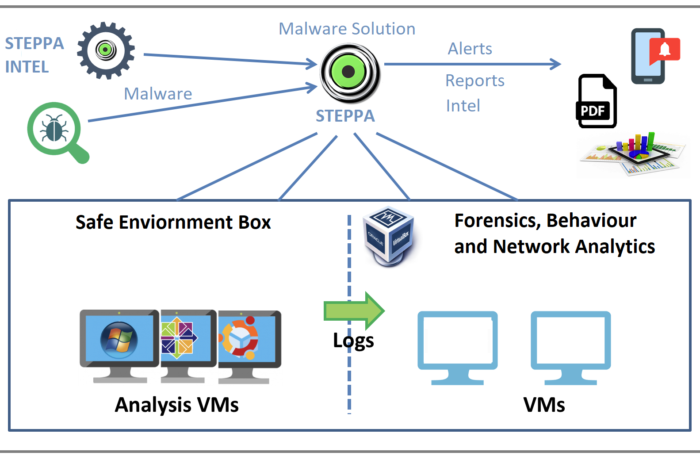
The Steppa Malware Analysis Platform is an intelligence-driven cybersecurity solution capable of processing more than 33,000 malware samples per day. This allows security teams to rapidly identify emerging cyber threats and analyze malware behaviors efficiently.
The platform integrates two key technologies:
- Steppa Malware Threat Intelligence Feed – continuously collects malware samples and threat intelligence from global sources.
- Advanced Sandbox Technology – executes suspicious files in an isolated environment to safely analyze malware behavior.
Through automated processing, the platform identifies malicious activities such as:
- Command and Control (C&C) communications
- Botnet infrastructure identification
- Data exfiltration attempts
- Persistence mechanisms used by attackers
- Malicious network traffic and indicators of compromise (IOCs)
The platform can be deployed in the cloud or on-premise, providing flexibility for enterprises, research institutions, and security operations centers (SOC).
Automated Malware Investigation and Threat Intelligence
The Steppa platform generates detailed malware intelligence reports that help cybersecurity professionals understand malicious behavior and identify compromised systems.
These reports provide critical indicators including:
- Malicious IP addresses and domains
- Command-and-control infrastructure
- File hashes and malware signatures
- Registry and system modifications
- Network artifacts and attack indicators
Security teams can use these indicators to quickly detect infected machines and investigate cyber incidents. This helps organizations strengthen incident response and improve proactive threat detection.
The platform is built on extensive research and development (R&D) in malware detection, threat intelligence, and cyber attack investigation.
Our research teams have experience analyzing complex cyber threats such as:
- Advanced Persistent Threats (APTs)
- Ransomware campaigns
- Targeted cyber espionage operations
- Industrial control system malware
- Emerging zero-day malware threats
Through malware reverse engineering and behavioral analysis, our researchers continuously improve detection capabilities and expand threat intelligence datasets.
Ransomware and Advanced Threat Detection
Ransomware remains one of the fastest-growing cyber threats affecting organizations worldwide. Attackers frequently target sectors such as healthcare, finance, manufacturing, energy, and government infrastructure.
The Steppa malware analysis platform enables security teams to analyze ransomware samples and understand how these attacks operate.
Key capabilities include identifying:
- Encryption techniques used by ransomware
- Communication with attacker infrastructure
- Propagation methods across networks
- Persistence and evasion techniques
The platform also supports investigation of Advanced Persistent Threats (APTs). These attacks are typically designed to remain undetected inside networks for extended periods.
Through sandbox analysis and threat intelligence correlation, analysts can detect:
- Lateral movement techniques
- Data exfiltration channels
- Hidden persistence mechanisms
- Malicious attacker infrastructure
These capabilities support faster incident response, digital forensics, and cyber threat hunting.
Cybersecurity Threat Landscape in the UAE, GCC, and MENA Region
The United Arab Emirates (UAE) and the broader Gulf Cooperation Council (GCC) region have become global hubs for digital transformation, smart cities, financial technology, and industrial innovation.
However, rapid technological growth also increases exposure to cyber threats. Organizations across the Middle East and North Africa (MENA) region are increasingly targeted by ransomware groups, cybercriminal networks, and advanced persistent threat actors.
Recent cybersecurity reports highlight the growing scale of cyber attacks in the region. Ransomware incidents targeting UAE organizations have increased significantly in recent years as attackers focus on financial services, government systems, and digital infrastructure.
Threat intelligence research shows that ransomware activity in the Gulf region is primarily concentrated in:
- United Arab Emirates
- Saudi Arabia
These two countries represent the majority of ransomware incidents across the GCC.
Several factors contribute to the growing regional cyber threat landscape:
- Rapid digital transformation initiatives
- Expansion of smart city infrastructure
- Growth of cloud computing adoption
- Increased use of Industry 4.0 technologies
- Integration of IoT and industrial control systems
These trends significantly expand the attack surface available to cyber adversaries.
The Steppa malware analysis platform helps organizations across the UAE, GCC, and wider MENA region strengthen cybersecurity defenses through:
- Automated malware detection and behavioral analysis
- Investigation of ransomware and APT campaigns
- Identification of command-and-control infrastructure
- Threat intelligence sharing and cyber incident investigation
Case Studies
Our clients and researchers use the Steppa platform to investigate multiple cybersecurity research areas:
- Machine learning and artificial intelligence for malware detection
- Malware targeting blockchain and cryptocurrency platforms
- Malware affecting cyber-physical systems and OT technologies
- Botnet detection and command-and-control infrastructure analysis
- Ransomware investigation and remediation
- Detection and analysis of Advanced Persistent Threats (APTs)
- Malware targeting IoT, IIoT, and Industry 4.0 environments
Join the hundreds who benefited from our malware analysis tool and Contact us for a free demo.
Learn More Services & Products


